The Team
The consultant, the contractor, and the supply problem nobody warns you about: sixty approved consultants for the entire state of California.
Watch the lesson
Prefer reading? The full module is below, same content, same sources.
What you will learn
What you'll be able to do
- Describe the HUD 203(k) Consultant's role and when one is required.
- Recognize the consultant fee schedule bounds (ML 2024-13) and that the consultant fee is now financeable.
- Explain the California consultant supply constraint (60 active) and its practical consequence for scheduling.
- Identify what makes a contractor 203(k)-capable, which is the ability to float labor and materials between draws.
Read the lesson
THE BIG IDEA
Build the team before the pressure starts.
- Understand who prepares and verifies the repair scope.
- Ask about availability early.
- Ask contractors how they handle costs between draws.
Read one section at a time. Then explain the idea in your own words.
The consultant is not an inspector
If you are on a Standard 203(k), a HUD-approved 203(k) Consultant is not optional. The loan legally cannot close without one.1 On a Limited, you may hire one anyway.
People assume "consultant" means "the person who checks the work." That undersells it. The consultant writes the Work Write-Up, the itemized, priced scope of every repair. That document is what the appraiser values the finished house against, what the contractor bids to, and what the draw schedule pays out on. The whole loan is built on top of it.
They also perform draw inspections as work is completed, review change orders when the plan shifts, and reinspect when something is disputed.
One thing HUD is unusually blunt about, and you should hear it clearly:
"Inclusion of a Consultant on the Roster means only that the Consultant has met the qualifications. It does not create or imply a warranty or endorsement by FHA of the Consultant, nor does it represent a warranty of any work performed by the Consultant."1
Being on the roster means they cleared a bar, not that HUD vouches for them. Roster approval lasts two years, and consultants must recertify every two years to stay on it.1 Interview yours like you would interview anyone whose document your entire loan rests on. Ask how many 203(k) files they closed last year. The number will tell you a lot.
What a consultant costs
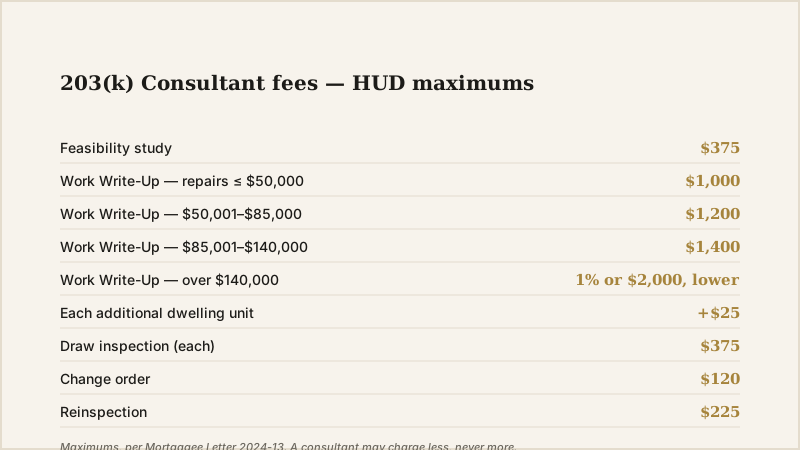
You are not at the mercy of a quote here. HUD publishes maximum fees. A consultant may charge less, never more.1
The numbers (maximums, per ML 2024-13, II.A.9.c):
Service Maximum Feasibility Study $375 Work Write-Up (repairs ≤ $50,000) $1,000 Work Write-Up (repairs $50,001–$85,000) $1,200 Work Write-Up (repairs $85,001–$140,000) $1,400 Work Write-Up (repairs over $140,000) 1% of repair costs or $2,000, whichever is lower Each additional dwelling unit +$25 Draw inspection (each) $375 Change order $120 Reinspection $225 Mileage IRS rate, if their office is more than 15 miles from the property Confirm it for your file: these are HUD's published maximums as of ML 2024-13. Ask your consultant for their fee schedule in writing before they start, and check it against this table.
Two things worth pocketing:
- The consultant's fee can now be financed into the mortgage.1 Before the 2024 rules it came out of your pocket at a moment when your pocket is already empty. On a Limited, where a consultant is optional, this quietly changes the math. A professional scope for a financed $1,000 is one of the better trades available to you.
- On a Limited, a Feasibility Study is not financeable. HUD's Limited ineligible-to-finance list is specific: Mortgage Payment Reserves, architectural/engineering professional fees, and a Feasibility Study.1 So that $375 is cash if you want one on a Limited. Often worth it anyway: it is the cheapest way to find out a house does not pencil.
Notice the change-order fee: $120, every time you change your mind. That is not a penalty, it is administration, but it is a real argument for getting the scope right before the work starts rather than redesigning the kitchen in week three.
Sixty people
Here is a number that reframes your timeline.
The number: As of a query of HUD's public consultant roster on July 14, 2026, there were roughly 60 active 203(k) consultants in the entire state of California, against a nationwide roster of about 1,327.2 Confirm it for your file: the roster changes as consultants are approved and recertify. Search HUD's current roster for your area rather than relying on our count.
Sixty. For thirty-nine million people.
Sit with the arithmetic. A Standard 203(k) cannot close without one of those sixty people. They are not distributed evenly. They cluster where the work is. Some counties effectively have none.
The practical consequence is not philosophical, it is calendar:
- Find your consultant early, before you are in contract, not after. On a Standard, an unavailable consultant is not an inconvenience, it is a stopped loan.
- Ask about their queue when you interview them. "How soon could you do a work write-up?" is a more useful question than almost anything else you will ask.
- This is a real reason a 203(k) takes longer than a conventional purchase. Not the only one, but a structural one, and it is worth knowing rather than discovering.
It also explains something you may have already run into: why so few people around you seem to know how this loan works. The supporting cast is genuinely small. That is a constraint, and it is also why a buyer who has done this homework is unusually well positioned.
What makes a contractor 203(k)-capable
Renovation money does not land in your bank account. It sits in an escrow account and is released in draws, as milestones are completed.1
Read that from your contractor's side. They buy the materials. They make payroll. Then they get paid, once the work is done and verified.
So the question is not just "is this contractor any good?" It is "can this contractor's business carry weeks of cost before money arrives?" Plenty of skilled, honest contractors cannot. That is a cash-flow reality, not a character flaw, and it is the single most common reason a 203(k) job goes sideways.
What to actually ask, before you pick anyone:
- "Have you worked a 203(k) draw schedule before?" Experience with the rhythm matters more than experience with your tile.
- "Can you carry materials and labor between draws?" Ask it directly. A contractor who hesitates is telling you something useful, and honestly.
- "What happens if an inspection delays a draw?" You want to hear a plan, not indignation.
The lowest bid is frequently the one that cannot absorb this rhythm. A contractor who walks off in week six is the most expensive contractor you can hire. You will pay someone else to finish, at emergency prices, on a loan with a clock running.
Module 5 is the mechanics of that clock: how draws actually work, what HUD changed about them three weeks ago, and what goes wrong.
PAUSE & RECALL
Try it on a home.
A contractor has a beautiful portfolio and the lowest bid. What else would you ask?
Compare your answer
Ask about renovation-loan experience, the ability to carry labor and material costs between draws, and the plan if a payment is delayed.
References for this lesson
-
HUD Mortgagee Letter 2024-13, "Revisions to the 203(k) Rehabilitation Mortgage Insurance Program including updates to the 203(k) Consultant Requirements and Fees," July 9 2024, effective for case numbers assigned on or after November 4 2024. https://www.hud.gov/sites/dfiles/OCHCO/documents/2024-13hsgml.pdf (full text retrieved and fee schedule extracted verbatim 2026-07-16) ↩↩↩↩↩↩↩
-
HUD/FHA Connection, 203(k) Consultant roster public lookup (status = Active). https://entp.hud.gov/idapp/html/f17cnsltdata.cfm (queried 2026-07-14; counts change as the roster is updated) ↩
Check yourself
Loading the knowledge check…
Sources and dates
Sources
- HUD Mortgagee Letter 2024-13, Revisions to the 203(k) Rehabilitation Mortgage Insurance Program. https://www.hud.gov/sites/dfiles/OCHCO/documents/2024-13hsgml.pdf (VERIFIED, retrieved 2026-07-16)
- HUD/FHA Connection, 203(k) Consultant roster public lookup (status = Active). https://entp.hud.gov/idapp/html/f17cnsltdata.cfm (SUPPORTED, retrieved 2026-07-14)